Commentary
This funny top ten list pokes fun at the way many old-time church hymns include words that are obscure, archaic, or no longer in common use. This is perhaps not surprising given that many hymns were written over 100 years ago!
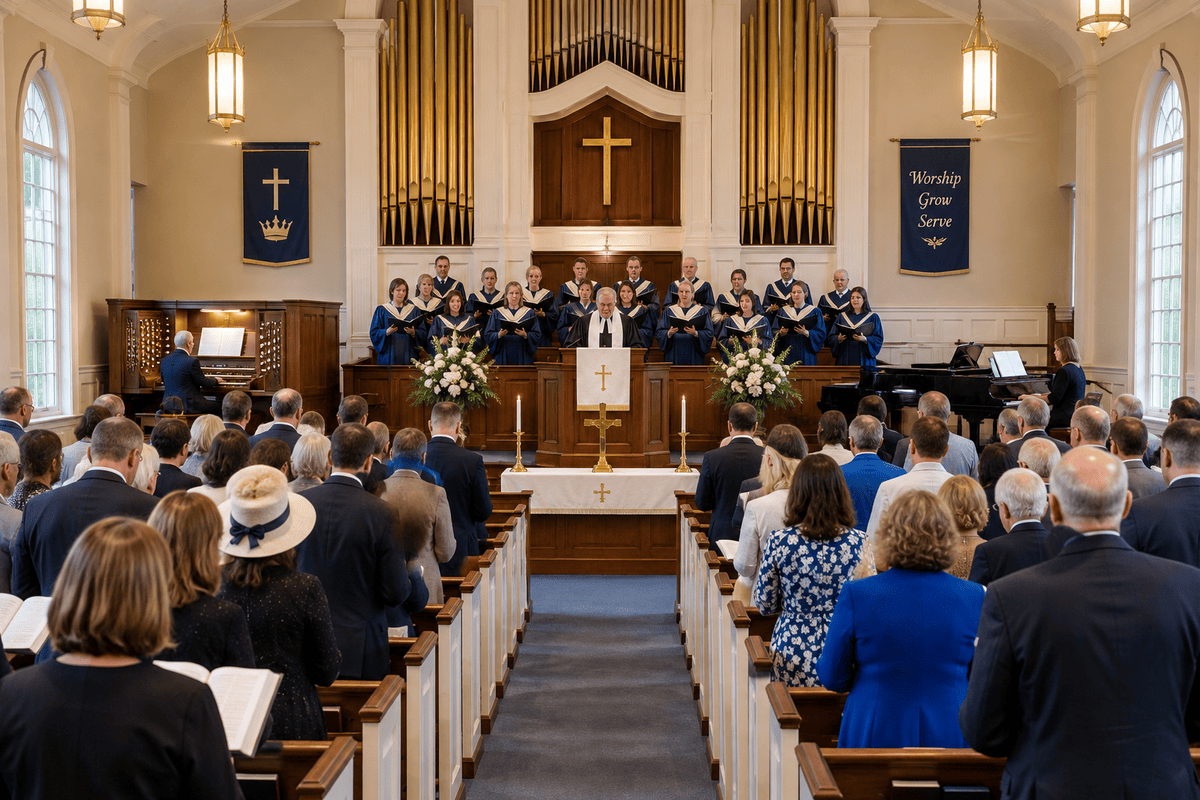
Modern Christian churches have generally moved on from hymns sung by the congregation and accompanied by organ and piano, to praise-and-worship music sung by a team and accompanied by a band including guitar, bass guitar, keyboard, and drums. However, our webmaster is an old fart who grew up in the Baptist church and is still quite fond of his old-time hymns. Some modern churches pay homage to hymns by having two services: a "traditional" one for old farts like Klugmeister, and a "contemporary" one for young-uns who enjoy songs with no melody and can't seem to get up early. Dacht.
Anyhoo, we've generally extracted these examples of unusual words from the more popular hymns, though we're rather embarrassed that we left off "How Great Thou Art." Perhaps we'll make amends by extending this topic to a series of two lists? Ah, don't hold your breath.
The word "wrought" (item 10) is no longer in common use except for the phrase "wrought iron." The meaning is the past tense of "make" or "create". The word appears in multiple hymns including "This is My Father's World" (his hands the wonders wrought) and "Since Jesus Came Into My Heart" (what a wonderful change in my life has been wrought). In addition, "I Know Whom I Have Believed" (item 10) includes the lines "nor how believing in His Word wrought peace within my heart." The refrain is based on 2 Timothy 1:12.
Old-time hymns and poems may also include quirky contractions such as "tis" (for "it is"), "twill" (for "it will"), and "oe'r" and ne'er" (for "over" and "never"). These adjustments help the author match the number of syllables in the lyrics to the number of syllables in the tune. For example, "twill" (item 9) is used in "I Love to Tell the Story" via the line "Twill be my theme in glory." In order to syllable-match, a word can likewise be stretched to an extra syllable, as with "story" in "I Love to Tell the Story." An extreme example is "gloria" which can easily be expanded from three syllables to 15 or 20 for just the right Christmas song. Ha!
Item 8 includes "diadem" which is another word for crown or tiara. (It's something you bring forth after angels prostrate fall, lol.) "Billows" are waves, often used in the context of the sea (as with item 5's "when sorrows like sea billows roll"). "Fount" refers to a fountain or source (item 4). "Yonder" (item 1) is a southern word meaning "over there"; it shows up in hymns like "When the Roll is Called up Yonder" and "Going up Yonder" written by Walter Hawkins (1975).